- Habitat
- Open grassland
- Weight
- 1,600–2,300 kg
- Diet
- Grazer
- Lifespan
- 40–50 years
- Social Life
- Small groups
Scientific Name
Ceratotherium simum
IUCN Status
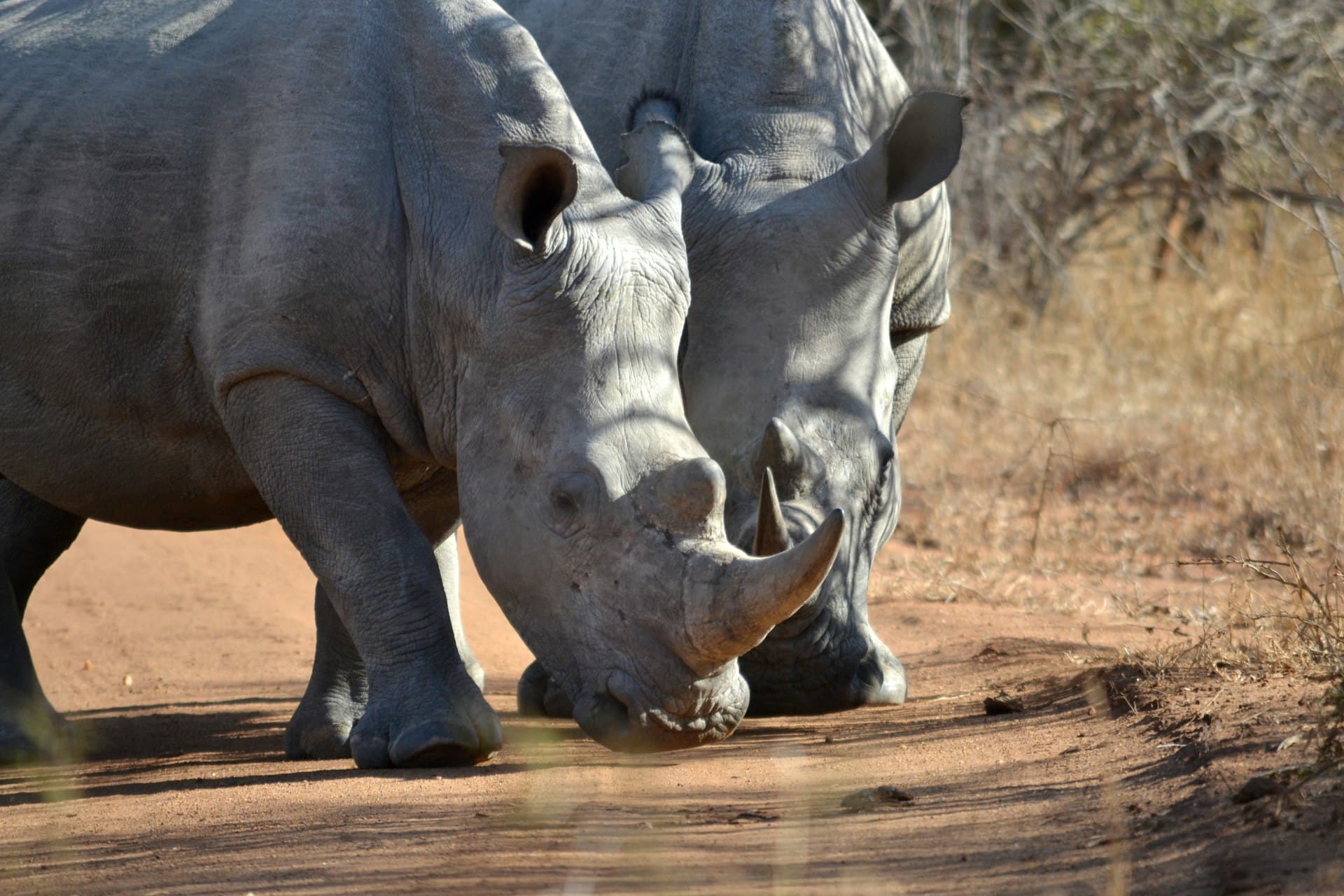
NT · Near ThreatenedAfter the elephant, the white rhino is the largest land mammal on earth. Its name has nothing to do with colour — it is grey, like the black rhino. The clue is its broad, square mouth, built for mowing short grass, and a large hump on the neck that supports its heavy, low-slung head.
White rhinos are calmer and more sociable than black rhinos. Females and their calves often move in small groups, and it is common to see several grazing peacefully together in the open.
A century ago the southern white rhino was down to a tiny population in South Africa. Careful protection brought it back to become the most numerous rhino in the world, and the species is now listed as Near Threatened — though poaching remains a constant threat.
Telling white and black rhinos apart
Look at the mouth first. A wide, square lip held close to the ground means a grazing white rhino; a pointed, hooked lip reaching into bushes means a browsing black rhino.
Watch the head and the calf. White rhinos carry their heads low and their calves usually walk in front of the mother, while black rhinos hold their heads higher and their calves tend to follow behind.
In Tanzania, the wild rhinos you are most likely to meet — in the Ngorongoro Crater and the Serengeti — are black rhinos. Knowing these differences lets you appreciate just how special each sighting is, and our guides are always happy to talk you through the details on a game drive.
Where to See Them
White rhinos are not part of the wild rhino populations in the parks we visit — on a Tanzanian safari, the rhino you see will be a black rhino.