- Habitat
- Bush & thicket
- Weight
- 800–1,400 kg
- Diet
- Browser
- Lifespan
- 35–50 years
- Social Life
- Mostly solitary
Scientific Name
Diceros bicornis
IUCN Status
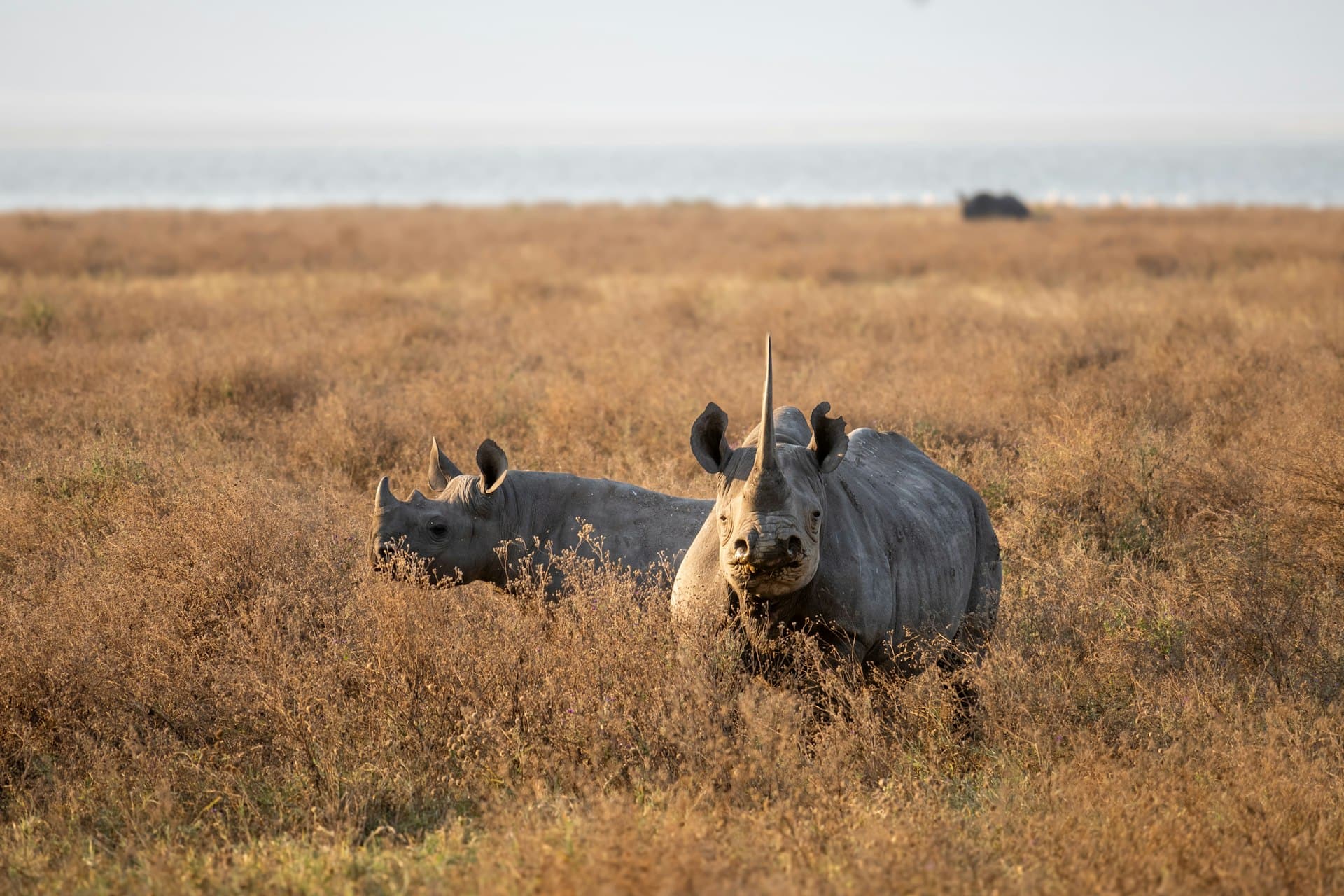
CR · Critically EndangeredThe black rhino is not black at all — it shares the same grey hide as its white cousin. The real difference is at the front: a pointed, hooked upper lip built for plucking leaves, shoots and twigs from shrubs, rather than grazing grass. Tanzania’s animals belong to the eastern subspecies, Diceros bicornis michaeli.
Poaching for horn wiped out most of East Africa’s rhinos in the 1970s and 1980s. Today the species is listed as Critically Endangered, and every surviving Tanzanian rhino lives under the eye of dedicated ranger teams. Seeing one is a privilege — and a sign that protection works.
Black rhinos are usually solitary, with poor eyesight but excellent hearing and smell. They can be short-tempered when surprised, which is why our guides always give them plenty of room.
Top tips for spotting black rhinos
Your best chance anywhere in Tanzania is the floor of the Ngorongoro Crater. The open grassland makes these secretive animals far easier to see than in thick bush, and a small resident population is closely monitored by rangers.
Bring binoculars and be patient. Rhinos are often seen at a distance, resting in the open or moving slowly along the edge of the Lerai Forest. Early morning, when the crater floor is quiet and the light is soft, is the golden hour for sightings.
In the Serengeti, rhinos are protected around the Moru Kopjes in the south-west of the park. Sightings there are rarer, so treat any encounter as a bonus rather than a plan.
Where to See Them
Ngorongoro Crater offers the most reliable sightings; the Moru Kopjes area of the Serengeti is a rarer bonus.